
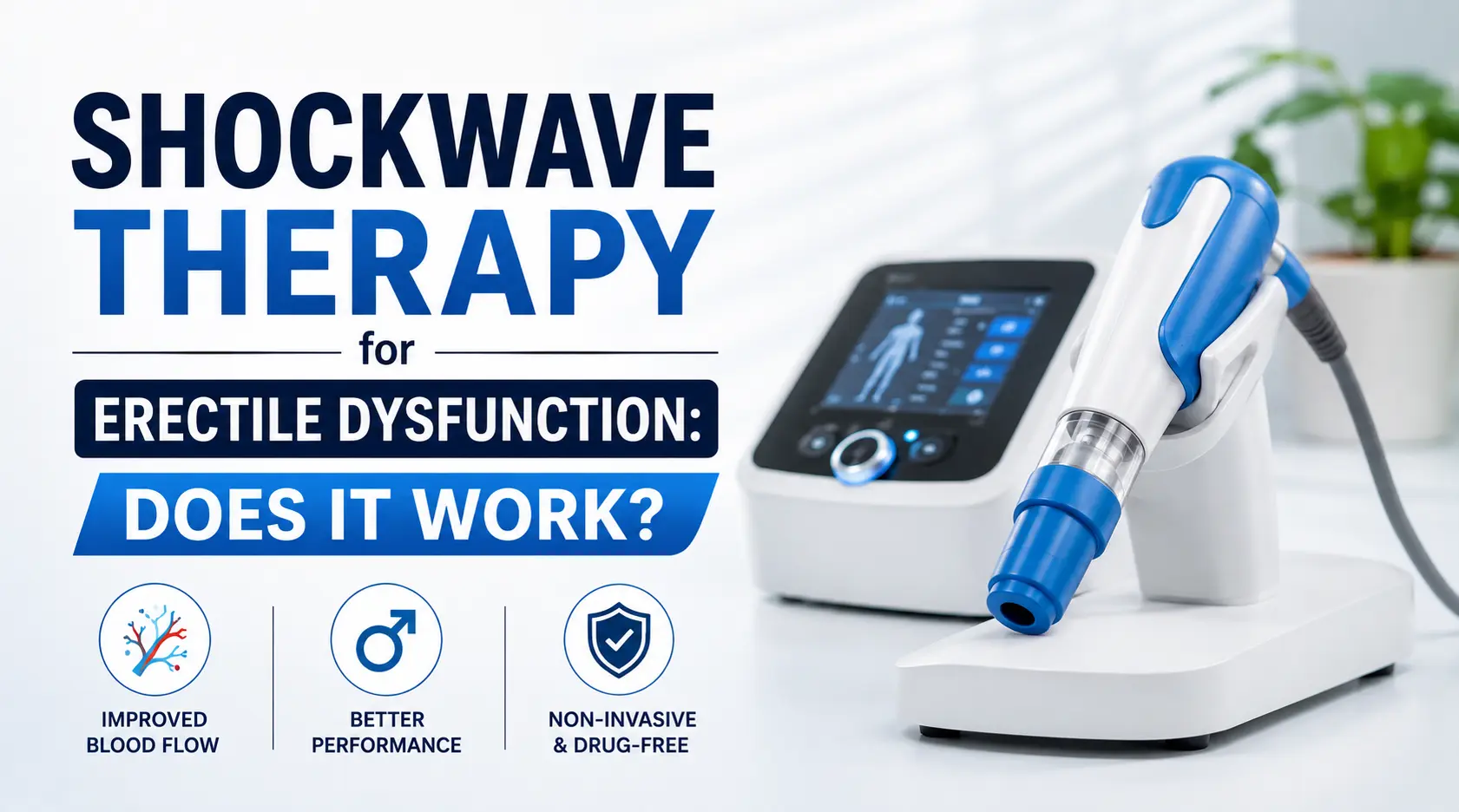
Low-intensity extracorporeal shockwave therapy (Li-ESWT) has become one of the most talked-about options for men looking for a drug-free, non-invasive way to treat erectile dysfunction (ED). Clinics market it as a way to “restore” natural erectile function rather than just masking symptoms the way pills do. But what does the actual clinical evidence say? Below, we look at how the treatment works, what the research shows, who’s likely to benefit, and how it stacks up against other ED treatments.
What Is Shockwave Therapy for ED?
Shockwave therapy uses a handheld device to deliver low-intensity acoustic pulse waves to the penile tissue. The idea is that these pulses stimulate the growth of new blood vessels (a process called neovascularization) and improve blood flow to the penis — since a large share of ED cases are vascular in origin.
The technology itself isn’t new. Higher-intensity shockwaves have been used for decades in urology to break up kidney stones and in orthopedics to promote tissue healing. The version used for ED relies on much lower energy levels and is typically applied in a series of in-office sessions, often without anesthesia, lasting about 15–20 minutes each.
Does It Actually Work? What the Research Shows
This is where things get more nuanced than most marketing materials suggest.
The evidence is mixed, not definitive. A comprehensive systematic review of restorative ED therapies found that results for focused shockwave therapy compared to placebo (sham treatment) were inconsistent — some trials showed meaningful improvement, while others found no real difference between the treatment and sham groups. Many of the studies also had methodological weaknesses, including inconsistent ways of measuring what counts as a clinically meaningful improvement.
A 2026 Cochrane-affiliated review offers cautious optimism. This analysis found that low-intensity shockwave therapy may produce a modest improvement in erectile function in the short term, with a somewhat larger effect reported in the long term, and it appeared to improve short-term penile rigidity as well. However, the review rated the overall certainty of this evidence as low, due to variability between studies, and noted that whether these improvements are large enough to matter to patients in everyday life is still unclear.
Side effects appear to be minimal. Across the reviewed studies, shockwave therapy did not lead to a meaningful increase in adverse events or in patients dropping out of treatment, which is reassuring from a safety standpoint even where efficacy data is uncertain.
No standardized protocol exists yet. A 2026 review highlighted that there’s still no expert consensus on the ideal number of sessions, energy level, or pulse count — meaning results can vary significantly depending on which clinic and device protocol you use.
Regulatory status. In the U.S., shockwave therapy devices for ED have not received FDA approval specifically for this indication, and major urology guidelines (such as those from the American Urological Association) continue to classify it as investigational rather than a standard-of-care treatment.
Who Might Benefit Most
The research suggests shockwave therapy may be most promising for men with:
- Mild to moderate vasculogenic ED (ED caused by blood flow problems rather than psychological, hormonal, or nerve-related causes)
- A partial response to PDE5 inhibitors (like Viagra or Cialis) — some studies suggest shockwave therapy may improve how well these medications work afterward, though this needs further confirmation
- A preference for a non-drug, non-surgical option, or a medical reason they can’t take oral ED medications
Men with severe ED, significant nerve damage (such as after prostate surgery), or purely psychological ED are less likely to see significant benefit, based on current data.
Read More: Super Kamagra Tablets Suppliers in UK
How It Compares to Other ED Treatments
| Treatment | Invasiveness | Evidence Strength | Typical Onset |
|---|---|---|---|
| Oral medications (PDE5 inhibitors) | Non-invasive | Strong, well-established | Within hours |
| Shockwave therapy (Li-ESWT) | Non-invasive | Mixed / low-certainty | Weeks to months |
| Vacuum erection devices | Non-invasive | Moderate | Immediate (per use) |
| Penile injections | Minimally invasive | Strong | Minutes |
| Penile implants | Surgical | Strong | Permanent solution |
Shockwave therapy is generally positioned as a complement to, not a replacement for, first-line treatments — at least until larger, standardized trials produce more consistent results.
What to Expect: Cost, Sessions, and Timeline
- Sessions: Most protocols involve 6–12 sessions over several weeks, though this varies widely by clinic.
- Cost: Because it’s not FDA-approved for ED and is often considered elective, it’s typically not covered by insurance. Total costs commonly range from $1,500–$6,000, depending on location and provider.
- Timeline: Clinics generally report that men who notice benefits tend to see them within one to three months, with initial changes sometimes appearing within the first few weeks — though there isn’t yet enough long-term data to confirm how durable the results are or whether repeat treatments will eventually be needed.
Is It Worth Trying?
Shockwave therapy for ED sits in a gray area: it’s low-risk and biologically plausible, and some studies show real (if modest) benefit — but the overall evidence base isn’t strong enough for major medical bodies to endorse it as a standard treatment. If you’re considering it, it’s worth:
- Talking to a urologist about whether your ED is likely vascular in origin (the group most likely to respond)
- Asking any clinic offering the treatment about their specific protocol and its evidence base
- Setting realistic expectations — meaningful improvement isn’t guaranteed, and it likely won’t fully replace other treatments for moderate-to-severe ED
Frequently Asked Questions
Is shockwave therapy FDA-approved for erectile dysfunction? No. Devices used for this purpose have not received FDA approval specifically for ED, and it’s currently classified as investigational by major urology guideline bodies.
How many shockwave therapy sessions does it take to see results? Most protocols use 6–12 sessions, with some men reporting initial changes within a few weeks and fuller effects within one to three months.
Are there side effects of shockwave therapy for ED? Studies have generally found no significant increase in serious side effects compared to sham treatment; mild, temporary discomfort during sessions is the most commonly reported issue.
Does insurance cover shockwave therapy for ED? Typically not, since it isn’t FDA-approved for this specific use and is usually classified as an elective treatment.
This article is for informational purposes only and does not constitute medical advice. Talk to a licensed urologist or healthcare provider to determine the best treatment approach for your individual situation.
Written By: Dr Tom Dickens

Reviewed By : Dr David Ziegelmann
Published Date: 25 Aug 2026
Last Reviewed: 25 Aug 2026
Category: Erectile dysfunction
Reading Time: 8 min read
